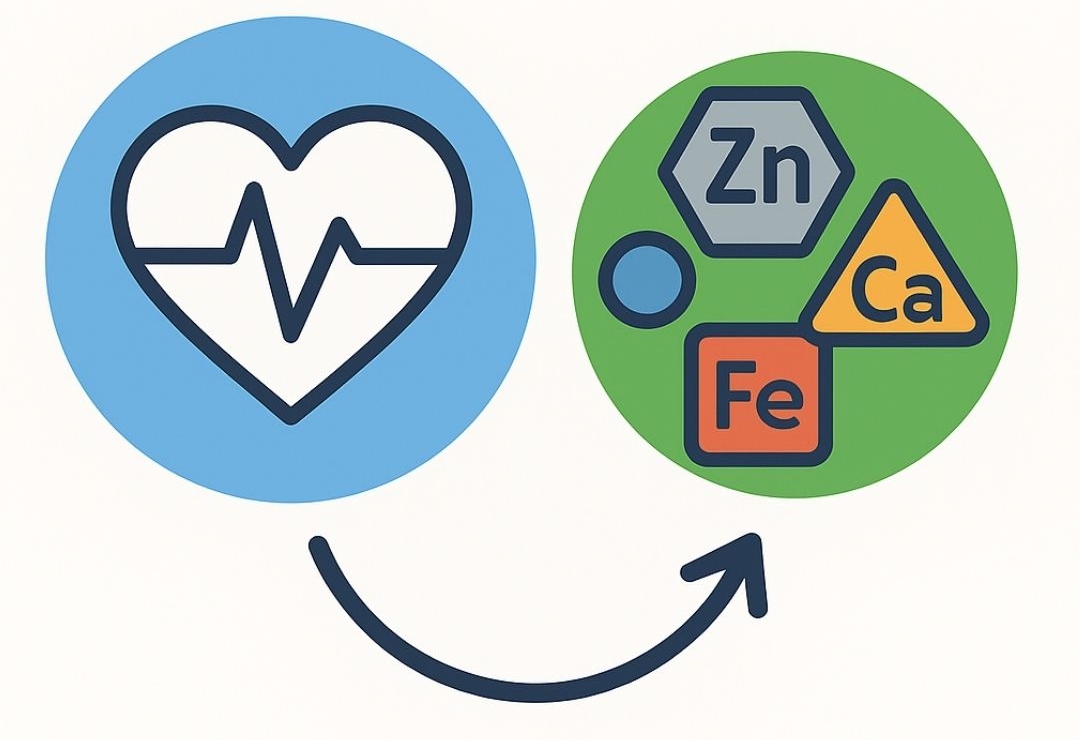
OligoCheck and CardiCheck are rapid, non-invasive functional assessment tools used in a preventive healthcare approach and to optimize health.

They are not a substitute for medical supervision, but they can help guide a personalized strategy to support the body and prevent certain imbalances.

oligoscan

OligoCheck and CardiCheck at the Natural Clinic with Philippe Lavigne (ASCA certified)

To support our patients in preventing illness and optimizing their health, we can use rapid, non-invasive functional assessment tools.

  • OligoCheck assesses the status of trace elements, minerals, vitamins, and certain heavy metals in body tissue, providing a comprehensive overview of the body's condition and reserves.

  • CardiCheckanalyzes the pulse wave to provide information on the flexibility and elasticity of the arteries, contributing to a preventive approach to cardiovascular health.

These two tools are not a substitute for medical monitoring, but they provide functional markers and keys to prevention, enabling early intervention, supporting the body, and promoting its natural capacities for restoration and balance.

Based on the results, the therapist will suggest a personalized strategy to regulate your body, support your vital functions, and prevent future imbalances. This strategy is mainly based on nutrition and micronutrition. nutrition and micronutrition (dietary supplements) tailored to a given period.

oligocheck

What is OligoCheck and what is it used for?

OligoCheck is a rapid, non-invasive measurement tool that can assess, in real time and at the level of body tissues, the status of trace elements, minerals, vitamins, and the presence of certain heavy metals.

The analysis highlights any deficiencies, excesses, or overloads, providing a comprehensive overview of the patient's condition, i.e., how the entire body functions and reacts to potential imbalances.


They do not constitute a medical diagnosis, but provide valuable information on the balance of the body's reserves and functions, sometimes before the onset of more pronounced disorders.

OligoCheck thus makes it possible to intervene in an intermediate state of health, between optimal balance and illness.
In this context, the objective is to support the body, strengthen its reserves, and accompany a nutritional and micronutritional approach aimed at improving well-being and promoting the body's natural restorative abilities.

This tool is part of an integrative and functional approach to health, establishing an assessment of the current situation and providing useful keys to prevention and optimization of well-being before functional imbalances become more severe.

The examination is performed using spectrophotometry on four specific points on the palm of the hand, without pain or sampling.

oligocheck chart

OligoCheck: What is the difference between this and a blood test?

OligoCheck and blood tests are two very different assessment methods, both in terms of their approach and their objectives.

OligoCheck is a non-invasive test performed using skin spectrophotometry (on the palm of the hand).
It assesses the tissue status of trace elements, minerals, vitamins, and heavy metals.
It provides a functional and comprehensive overview of tissue reserves, without any injections or blood samples. The results are immediate.

A blood test, on the other hand, is a medical biological test that measures the concentration of substances in the blood at a specific point in time.
It is used to make a medical diagnosis, monitor a condition, or adjust treatment, and requires a sample to be taken, often in a laboratory.

What is CardiCheck and what is it used for?

CardiCheckis a rapid, non-invasive assessment tool that analyzesthe pulse wave to obtain information about the functioning of the cardiovascular system.

With each beat, the heart generates a wave that propagates through the arteries.
Analysis of the shape, speed, and reflection of this wave makes it possible to assess arterial flexibility,vascular elasticity, and certain indicators related to the quality of circulation.


They do not constitute a medical diagnosis, but provide valuable information on the functional state of the arteries and how the body adapts to stresses such as stress, aging, or metabolic imbalances.

CardiCheck can therefore identify an intermediate state of vascular health, sometimes before the onset of more pronounced disorders or overt hypertension.
In this context, the aim is to support a preventive approach by promoting healthy lifestyles, stress management, physical activity, and a balanced diet.

This tool is part of an integrative and functional approach to cardiovascular health, establishing an assessment and providing useful keys to preserving the flexibility and balance of the vascular system over time.

The test is performed using a sensor placed on the finger.
It is painless, does not require a blood sample, and takes only a few minutes.

cardicheck

What is the difference between CardiCheck and conventional blood pressure measurement?

Although both tests concern the cardiovascular system, they do not measure the same thing.

🩺 Conventional blood pressure

Blood pressure measurement (using a cuff on the arm) assesses the pressure of blood in the arteries at a specific moment.

She gives two figures:

  • Systolic pressure (when the heart contracts)

  • Diastolic pressure (when the heart relaxes)

It is an essential medical indicator for detecting or monitoring high blood pressure. It measures pressure.

❤️ CardiCheck by pulse wave analysis

CardiCheck analyzes the shape and propagation of the pulse wave generated by each heartbeat.

He studies:

  • Arterial flexibility

  • Vascular stiffness

  • Arterial elasticity

  • Estimated vascular age

It assesses the functional quality of the arteries.

In summary

  • Blood pressure = how much pressure in the arteries

  • CardiCheck (pulse wave) = how the arteries behave

The two tests are complementary: blood pressure provides information about immediate pressure, while pulse wave analysis provides a more comprehensive and preventive view of vascular health.

cardicheck chart
complementarity

The complementarity between OligoCheck and CardiCheck

OligoCheck and CardiCheck do not provide the same information, but complement each other.:

  • OligoCheck identifies deficiencies and excesses in minerals, vitamins, trace elements, and heavy metals in body tissue, which can disrupt metabolism and energy levels.
  • CardiCheck assesses the possible consequences of these imbalances on the cardiovascular system and physiological stress, revealing, for example, signs of fatigue, stress, or metabolic adaptation.

By combining the two analyses, we obtain a more comprehensive and accurate overview, enabling us to propose customized and consistent solutions.

Bioresonance

Complementarity with bioresonance

Bioresonance is an approach that allows certain energy disturbances in the body to be detected and rebalanced.

Based on the results of OligoCheck and CardiCheck, bioresonance can more precisely target areas or functions of the body that need rebalancing.

Together, these tools provide a comprehensive assessment of the body in terms of nutrition, function, and energy, enabling more effective and comprehensive monitoring.

From what age?

These tests are suitable for adults and children aged 5 and above.

Before the age of 5, the session may be too complex: sitting still, following instructions, and taking dietary supplements can be difficult for younger children.

Rates

A one-hour session

A 1-hour session

160 CHF

Get your OligoCheck and CardiCheck at La Clinique Naturelle with: